


If you or your loved one is diagnosed with AMD, you must be going through a lot of stress, which is totally understandable. After all, this eye condition can lead to blindness if not treated on time. According to one report, there are over 20 million Americans aged 40+ who are living with some form of macular degeneration.
The good thing is that learning about the processes and measures to slow down the condition can help you protect your vision for a longer time.
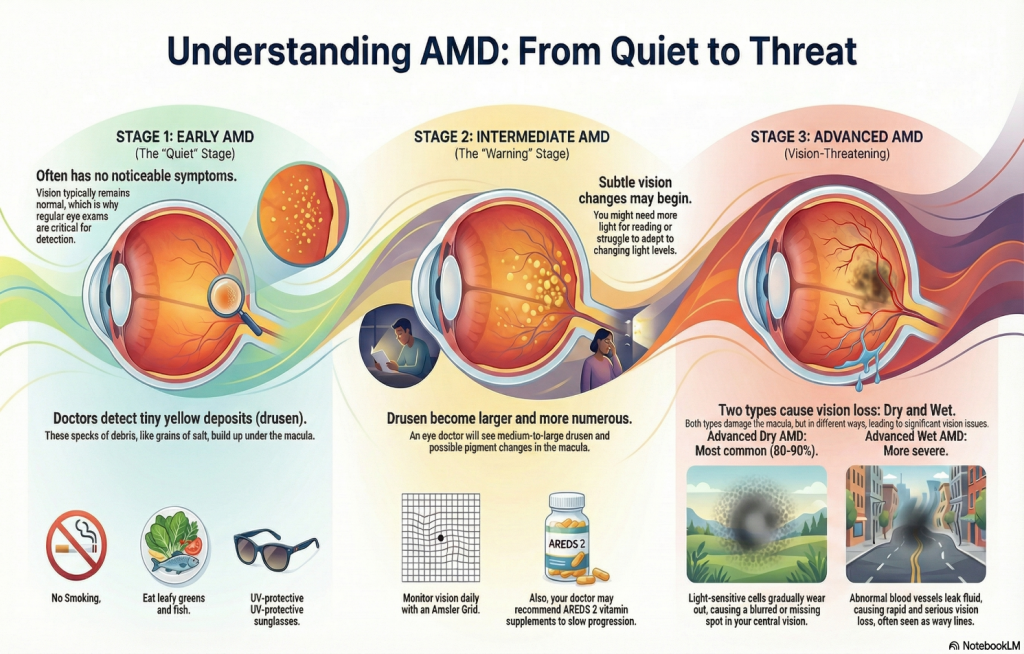
What is Macular Degeneration or AMD?
Think of your eye like a camera.
The back of the camera is equipped with a special film called the retina. There is an important spot called the macula located in the middle of the retina. The macula is responsible for keeping your vision sharp and in top shape. You rely on this vision to read, drive, and recognize faces as well as to see colors clearly.
And macular degeneration, or Age-related Macular Degeneration (AMD), is simply a condition that affects the macula. The macula starts to wear down as we age. Although it doesn't lead to total blindness, it can make that sharp central vision blurry or distorted. No wonder you find it challenging to do everyday tasks with AMD. Macular degeneration is not curable. However, you can manage the symptoms and slow down the progression with treatments and lifestyle changes.
But AMD doesn’t happen all at once. It occurs through the stages. The earlier you get to know about it, the better chance you have to slow it down.
Understanding the Stages of Macular Degeneration or AMD
1. Early AMD: The "Quiet" Stage
This is the very first stage of AMD.
However, it is often termed as the quiet stage. This is because you may not notice any changes to your vision. That’s why regular eye exams are highly recommended to detect any underlying changes in your vision.
(Also Read: Understanding the Early AMD Signs.)
What Does the Doctor See?
Your macula is checked for the presence of tiny yellow deposits called drusen (droo-zen). They are specks of debris building under the macula.
The drusen are generally small—like grains of salt—in the early stage. However, there may be a few medium-sized drusen.
What Does This Stage Mean for You?
Vision Impact: There is no significant change in your vision as it stays absolutely normal. You generally don’t experience any blurriness or a dark spot.
Risk: Although it happens without any harm, the early stage progresses to the next stage.
What to do
This is the stage where you can make some changes to protect your vision for the long run.
- Keep up with regular, comprehensive eye exams. It helps your doctor track the drusen and any changes to the macula.
- Quit smoking, as it is the single biggest risk factor for AMD.
- Add dark, leafy green veggies like spinach, fish (salmon), and kale to your diet. These foods are a good source of vitamins that benefit your macula.
- Wear sunglasses with UV protection when outdoors.
2. Intermediate AMD: The Warning Stage
This stage is the middle ground. While you may not experience any significant changes to your vision in this stage, this often comes with a warning.
What Does the Doctor See?
This stage is characterized by an increased amount of debris (drusen) accumulated under the macula. Your doctor can find several medium-sized drusen or at least one large drusen (about the size of the tip of a pencil eraser) in your eyes. There might be changes in the pigment (the color) in your macula. They are telltale symptoms that the damage has started affecting the vital supporting cells.
- Vision Impact: You might still experience no symptoms. But there might be very subtle changes, such as:
- A need for more light when reading.
- Minor problems in adapting to bright light to dark light (such as entering a darkened movie theater).
Risk: You are at a great risk of developing the disease at the advanced stage.
What to do
It is at this point that your physician will probably prescribe a certain, effective supplement.
AREDS 2 Supplements: Several studies have confirmed that taking high-dose vitamins and minerals can reduce the risk of intermediate forms of AMD developing into advanced forms. However, consult your eye doctor before taking any supplement.
Apply an Amsler Grid: Your physician might provide you with an Amsler Grid- a plain square grid with a dot at the center. You should use this at home every day to check each eye separately. In case the straight lines appear wavy, bent, or a blank space appears, contact your eye doctor immediately.
3. Advanced AMD: The Vision-Threatening Stage
This is the stage where MD is actually causing vision loss. Advanced AMD is categorized into two major types: Wet AMD and Dry AMD. Both types harm the macula, but in different ways.
A. Advanced Dry AMD (Atrophic)
It is the most prevalent form of progressive AMD, making up approximately 80-90 percent of the cases.
What Does the Doctor See?
The light-sensitive cells in the macula wear out gradually and progressively.
Geographic Atrophy (GA): The wear-and-tear has left a distinct, thinning region in the macula. Consider it as patches of grass that are dying in your lawn.
Risk:
It leads to a progressive loss of the central vision. You may have a blurred or missing spot, particularly in reading or attempting to see details. The spot may increase with time.
Treatment: There is no cure at present for advanced dry AMD. Nevertheless, there are new therapies under development, and the AREDS 2 vitamins can still slow down the progression in most cases.
B. Advanced Wet AMD (Neovascular)
Wet AMD is not as prevalent, but it is more severe, as it may lead to a rapid and serious vision loss.
What Does the Doctor See?
The main distinction in this case is the existence of abnormal and weak blood vessels that develop under the macula. These are new weak vessels that leak blood and fluid into the macula. It is this accumulation of fluid that causes the severe and rapid damage.
Risk:
- Vision impairment is usually abrupt and dramatic:
- Straight lines appear wavy or curved (a major indicator to observe on the Amsler Grid).
- There is a black or blank area in the middle of your eyes.
- The central vision may be easily distorted and blurred.
Treatment:
There is good news that there are effective treatments for these conditions! Injections (medication is injected into the eye) can prevent the development of the abnormal blood vessels and leakage. Although the thought of getting an injection in the eyes is frightening, it is a fast procedure that can save or even enhance vision.
Over to You…
Macular degeneration can feel stressful at first, but learning how it progresses helps you stay ahead of it.
Make sure to schedule regular eye exams as you age. While there is no cure for AMD, many patients manage it successfully for years with the right guidance and treatment.
We at Baumrind Eye offer tailored treatment and consultation for AMD patients, improving their quality of life and comfort. If you are looking for personalized guidance on AMD, reach out to us now!
FAQs
What are the stages of wet macular degeneration?
Wet macular degeneration is a condition that normally occurs at the late progression of AMD, whereby abnormal blood vessels begin to leak and quickly impair central vision.
Can early-stage macular degeneration disappear?
The initial macular degeneration cannot be reversed, but the development can be slowed down by following your doctor’s advice and making changes to your lifestyle.
What are the beginning stages of macular degeneration?
The initial phase is early AMD, in which small or medium-sized drusen exist, but the vision is typically normal.
What are the stages of age-related macular degeneration?
Macular degeneration in old age can be categorized into three stages: early, intermediate, and advanced stages that can be either dry or wet.


